Essay · Prospecting ·
Digging your own clay, and writing the data sheet yourself
Where clay hides, the five field tests that take a jar of water and a bottle of vinegar, and the one firing that decides everything else. Prospecting is the testing discipline you already owe your materials, applied to one that arrives unlabelled.
A bag of plastic stoneware delivered to your door costs less in working hours than a season of digging, screening, and test firing. That settles the economic question, and the economic question was the wrong one. The reason to dig your own clay is that a potter who has dug, tested, and fired a native clay reads every commercial bag differently afterwards. You stop asking what is in the bag. You start asking what was selected, what was rejected, and what the supplier did not bother to tell you.
The material gives you something as well. Colour is the most sensitive property in ceramics, and small shifts in trace minerals show up plainly on a fired surface. A natural clay carries its own fingerprint of iron, manganese and titanium, a combination that took geological time to assemble and that you cannot reproduce by stirring red iron oxide into a commercial body. Commercial clays are formulated for consistency and broad compatibility, and the formulating smooths those idiosyncrasies away. So the sane way to use found material is as a complement: buy your base ingredients from the supplier, and add local clay where it gives you something the catalogue cannot.
The question is not where clay is, it is where the cover has gone
Clay is common. Most countries hold far more usable clay in the ground than the supply industry will ever process. It is almost always covered, though, by topsoil in temperate country, by vegetation where it is wet, by drift sand or laterite elsewhere. The prospector’s question is where that cover has been stripped away.
Erosion strips it. Stream banks, river-cut bluffs, gully heads, escarpments, the base of a cliff after a storm. Outcropping rock holds its shape under rain and clay does not, so a face that has slumped into a smooth crumbly run after heavy weather, with a texture unlike the earth around it, is worth a closer look.
People strip it more often. Road cuttings, construction trenches, drainage works, well excavations, quarry walls, agricultural terracing. These artificial exposures are how most modern prospectors actually find a deposit. The digging has already been done, and the only question left is whether anyone with a potter’s eye has walked past. In a built-up area this is usually your one route to anything below the topsoil.
Geology tells you where to bother. Younger systems yield workable clays more often than old ones, because most clay older than the Devonian has been cooked into shale, slate, or something harder that will not develop plasticity until it has been ground. Flood plains repay attention more than rivers do: fluviatile clay sits out on the plain where the annual flood dropped it, not in the bed or the bank. Most national geological surveys publish maps of surface rock and surficial deposits, often free online, and even a coarse one will tell you within half a day’s drive where alluvium fills a valley or where a granite intrusion outcrops. Read the map before you carry a shovel anywhere.
The map, the neighbours, and the shovel
Field prospecting works as three activities running in parallel, and no one of them carries the other two.
Published geology is the first: your national survey, the mining and mineral-resource literature, university theses on local stratigraphy, even a tourist-board geological guide. The second is the people who already know. If there are clays to be found, somebody has found them and used them for something. Talk to whoever makes holes in the ground for a living, so well-sinkers, drillers, builders, masons, road-makers, drain-layers. Talk to gardeners and farmers, who watch their subsoil closely because the crop depends on it. Talk to the brickworks, the tile factory, the foundry, anyone using clay for a purpose that has nothing to do with pottery.
William Cookworthy identified the Cornish kaolin at Tregonning Hill in 1746 as a porcelain raw material, and he recorded that the same clay was already being used locally to patch the furnaces of tin smelters. The deposit had been working for the wrong industry for a generation before a potter recognised what it was. That is the ordinary shape of a find.
The third pillar is the pick-and-shovel work that ties the other two together. The map says where to start, the neighbours say where to dig, and the ground says what is actually there. A hand-dug test pit is no makeshift, either. Industrial kaolin operations still sink hand pits a metre wide and tens of metres deep when they first prove a deposit.
Presumed unsuitable until proved otherwise
That is the first rule a prospector learns, and the tests that settle it are quick. The kit is a jar of water, a bottle of household vinegar, and your thumb.
Feel. Wet a lump and press your thumb across it hard enough to polish the surface. Smooth and slightly glossy means the fine particles are aligning under pressure, so there is meaningful clay content. Rough and gritty however hard you press means sand or silt.
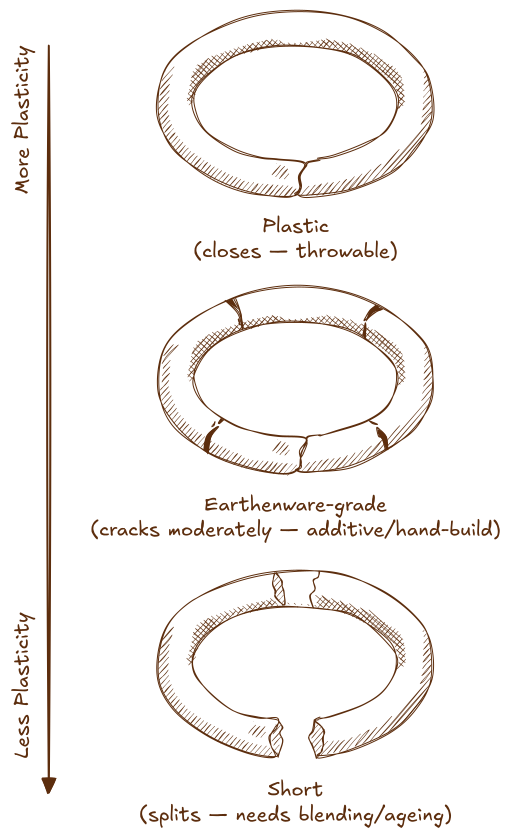
The coil ring. Roll a wet lump into a coil about as thick as a pencil and bend it into a ring roughly 25 mm (1 in.) across. A ring that closes with no cracking on the outer face has plasticity adequate for throwing. Moderate cracking is earthenware grade, useful as an additive or for hand-building. If it splits the moment it bends, the clay is short, and it will need blending with something more plastic, or grinding and ageing, before any further test means much. One minute, no equipment, and it answers the main question.
Slaking. Drop a lump of dry raw clay into a jar of water and leave it a few hours. A normal clay falls apart into a slurry unaided. A shale, a hardened white tropical earth, or a partly metamorphosed clay sits there nearly intact. Non-slaking material is not automatically useless, though it has to be crushed or ground before a plasticity test will say anything true.
Overnight scum. Leave the wet lump from the feel test to dry until morning. White staining or a scum forming on the surface as it dries means soluble alkalies. A trace is tolerable. Heavy efflorescence is a rejection.
Vinegar. Drop a piece of the dry raw clay into a shallow dish of vinegar. Fine bubbles rising off it mean calcium carbonate, and coarse calcite in a body gives you lime pops in the fired ware days or weeks after it leaves the kiln. Hydrochloric acid is the laboratory version and reacts harder, but vinegar finds anything large enough to matter.
What only the kiln will tell you
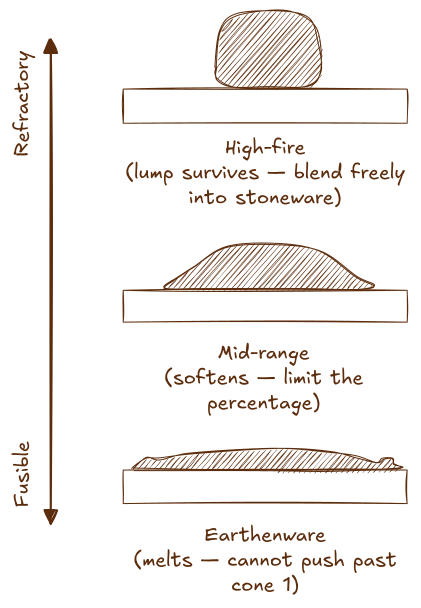
None of that says what the clay does at temperature. For that, set a small lump of the raw clay on a piece of bisque ware and fire it to your working temperature. If it comes through largely unchanged it is a high-fire material, and you can add it to a stoneware body freely. If it softens, deforms, or runs into a puddle, it is an earthenware clay, and every addition to a higher-firing body needs a percentage limit written against it.
The same firing previews the fired colour, which you cannot read off the raw material at all. Natural clays carry organic carbon that burns away in the fire, so a grey or black clay can come out cream, tan, or close to white. A yellow clay is hydrated iron oxide and will usually fire red in oxidation, dark brown to black in reduction. As a rough industrial guide, total iron reported as Fe₂O₃ governs it: under about 1% fires white, 1 to 5% fires tan, 5% or more fires red. Most surface clays found in the field run 2 to 5%, which is one reason they will not usually go above about cone 1 without losing their shape.
Label it at the source or lose it
Natural deposits are variable, and a bucket dug from one corner of a face will not match a bucket from three metres along. Clean off the fallen overburden and take material from the whole freshly exposed face, top to bottom, in roughly equal proportions. For a bulk sample, quarter it: wedge until it is uniform, spread it into a rough disc, cut it across twice, discard two opposite quarters, then wedge and repeat.
Then label the bag where you dug it. Collector, sample number, locality with grid reference or GPS coordinates, date, depth in the section, and whatever you could see: colour, layering, inclusions, distance to the surface. A sample without provenance becomes useless within months, and the bag with the data is worth ten bags without it. One number is worth recording while you are standing there. The stripping ratio is the thickness of overburden divided by the thickness of workable clay beneath it, and it tells you whether the deposit is worth returning to. A ratio of one is favourable, ten is rarely worth working, and the thresholds bend for an exceptionally clean clay. The numerator is what you have to move. The denominator is what you take home.
Most found clay is an ingredient, not a body
Expect what you carry home to be too sandy, too short, or loaded with impurities that misbehave in the fire. Very few found clays will throw on their own, and that is less of a disappointment than it sounds. Blend 5 to 10% of an iron-rich local clay into a commercial body and the fired colour moves in a way no measured dose of pure oxide reproduces, because the natural material brings its whole mixture of trace minerals along with it. Screen the same clay finer and it is a decorating slip. Thin that and it is a wash to brush over bisque and wipe back off the high points. Add a little feldspar and it becomes an engobe. Take only the finest fraction, by letting a deflocculated slip settle and decanting the top layer, and you have terra sigillata that burnishes to a soft sheen.
The quantities involved are small. A few kilograms of raw material, once screened, yields enough slip for months of work. A single bucketful out of a road cut is a reasonable starting supply, which is worth knowing before anyone plans an expedition.
The trap that catches the most people
Refractory clay, the kind that goes into kiln furniture, saggars, and the repairs you make yourself, is a separate problem, and it is where prospectors lose most often. Across tropical and subtropical regions there is a pale white earth that looks exactly like primary kaolin: white, fine, low in iron, occasionally sold locally as a refractory. Most of it is quartz sand with just enough clay binder to hold a shape. Bricks and saggars made from it behave for the first few firings, then begin to spall as the free silica reacts with kiln fly ash and slags down, and the saggar fails halfway through a load.
The check costs one test brick. Fire it to your working temperature, then fire it three or four more times. Spalling, slumping, or a glassy surface on the second or third round rules the material out whatever it did on the first. Real refractory clay is rare, and it is worth searching for deliberately rather than assuming a white earth will do.
Testing is the work
Any published recipe calling for “local clay” or “volcanic ash” is an approximation of somebody else’s material. Your clay is not their clay, your rock is not the same basalt, your ash is not from the same species of tree. Line blends are the efficient way through: hold a known recipe steady, vary the local material across a row of tiles, fire them in one load, and read off where it works and where it fails. Then write down the source, the processing, the ratios, the temperature, and the atmosphere, because a found material varies from site to site and from one collection to the next at the same site. Without the record, a good result is a one-time event.
That habit pays off a long way from the riverbank. Albany slip stopped being mined in 1986. Gerstley borate stockpiles ran out in 2022. Custer feldspar’s chemistry drifted through the 2000s, and several Tennessee ball clays have been reformulated under the recipes that depended on them. The discipline you build proving a bucket of roadside clay is the same discipline that rescues a glaze when a bag you have trusted for ten years quietly changes underneath it. Prospecting is not romance. It is the testing you already owe your materials, applied to one whose data sheet you have to write yourself.
This is an abstract of one chapter of The Form of Clay, a book I am writing on the craft and the physics behind it. The chapter carries the eight-step test sequence in full, the water-of-plasticity measurement, Leach’s test rings, the field identification of the five iron minerals you are most likely to pick up, and what it takes to turn a ground local rock into a glaze. It is close, but not finished. If you would like to know when it is out, ask for the letter and I will email you, or leave your address in the form below.